The joyful men and women in Susannah Martin’s spectacular paintings seem to celebrate life, the delighted dancers rejoicing in a dreamy landscape of arcadian alpine lakes and forests. The world of pure sensation is within reach to these wonderful creatures, in delicious settings one step removed from the ordinary perceptions of mere mortals, in an ideal environment enjoyed by beings separated from the dull limitations of ordinary physicality. Strange shining entities shimmer around them, formed into stretched and inflated foil party balloons, or brightly molded glass dragon ornaments, translucent and reflective, these unknown and incomprehensible forms extending into the plane we inhabit from other glowing levels where luminous beings beyond our comprehension live in light. Happy dogs as delighted as Martin’s men and women smile goofily and leap weightlessly in the opaque air, cheerful Chihuahuas, loopy lurchers and friendly Labradors floating happily in free fall beside scarlet dragons, all unrestrained by the heavy weight of gravity. This may be a piece of heaven, where spirits live blissful and unencumbered by the grey restraints of life, finding themselves in this moment, in this landscape of alpine pleasure and eternal spring.
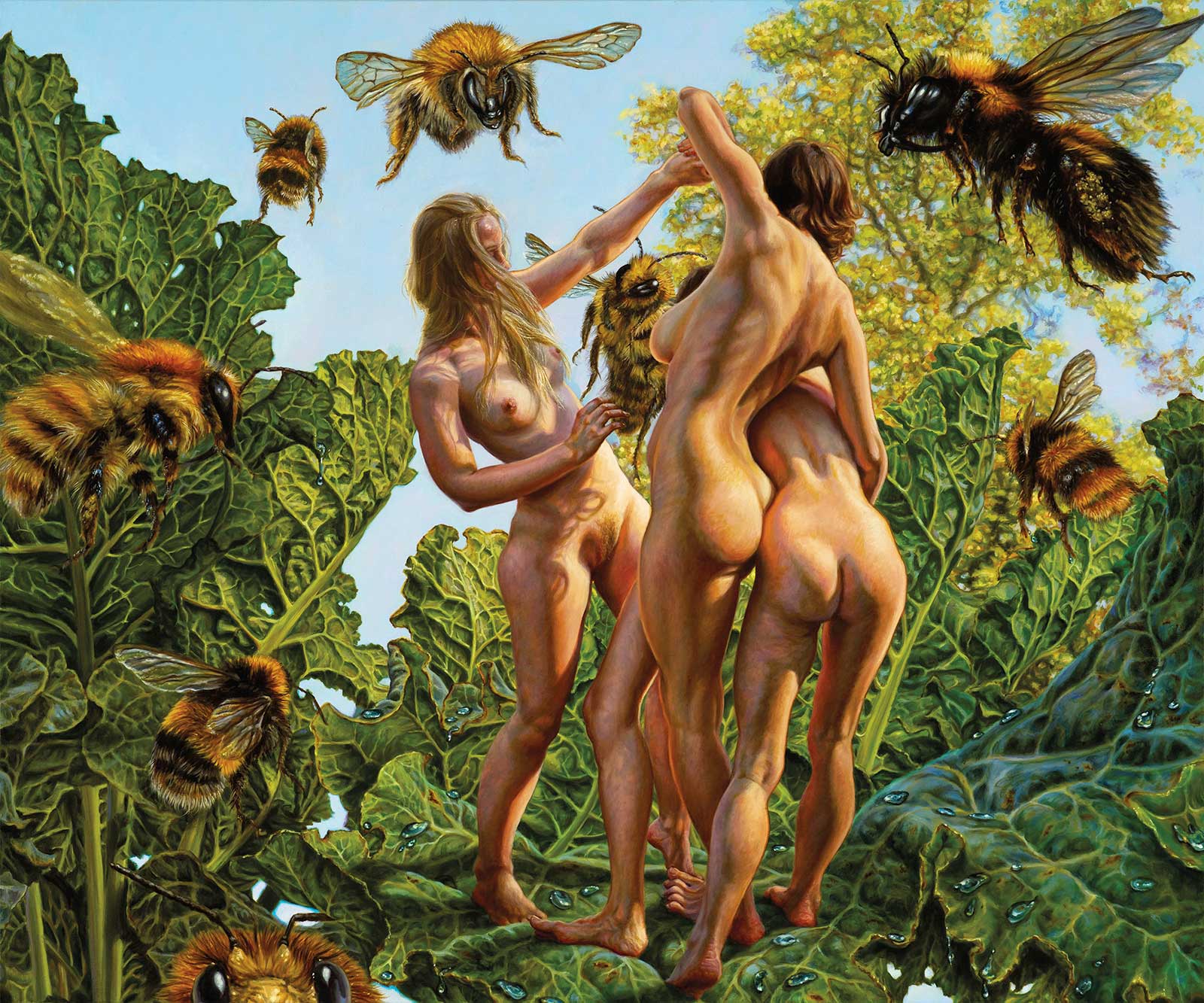 Swarm, 2024, oil on canvas, 39 1/3 x 47¼"
Martin explains, “I began to look at the psychedelic aspect of the ways human beings represent nature, and how fascinated we are by glass sculptures, or plastic sculptures, or various little knickknacks that people are charmed by. There’s a very specific charm that they have, it’s a way of cutifying nature by making it very small and putting it on a table, or holding it in your hand. I’m fascinated that human beings do that. I’m interested in the history of that—when did that start to happen, when did people start making little miniature animals, and why do we do that? It’s taken on a new level since industrialization and mass production. It’s such a human thing to want these items. I like to put these two things together—the parity of nature, so to speak, the symbolic representation of nature next to nature.”
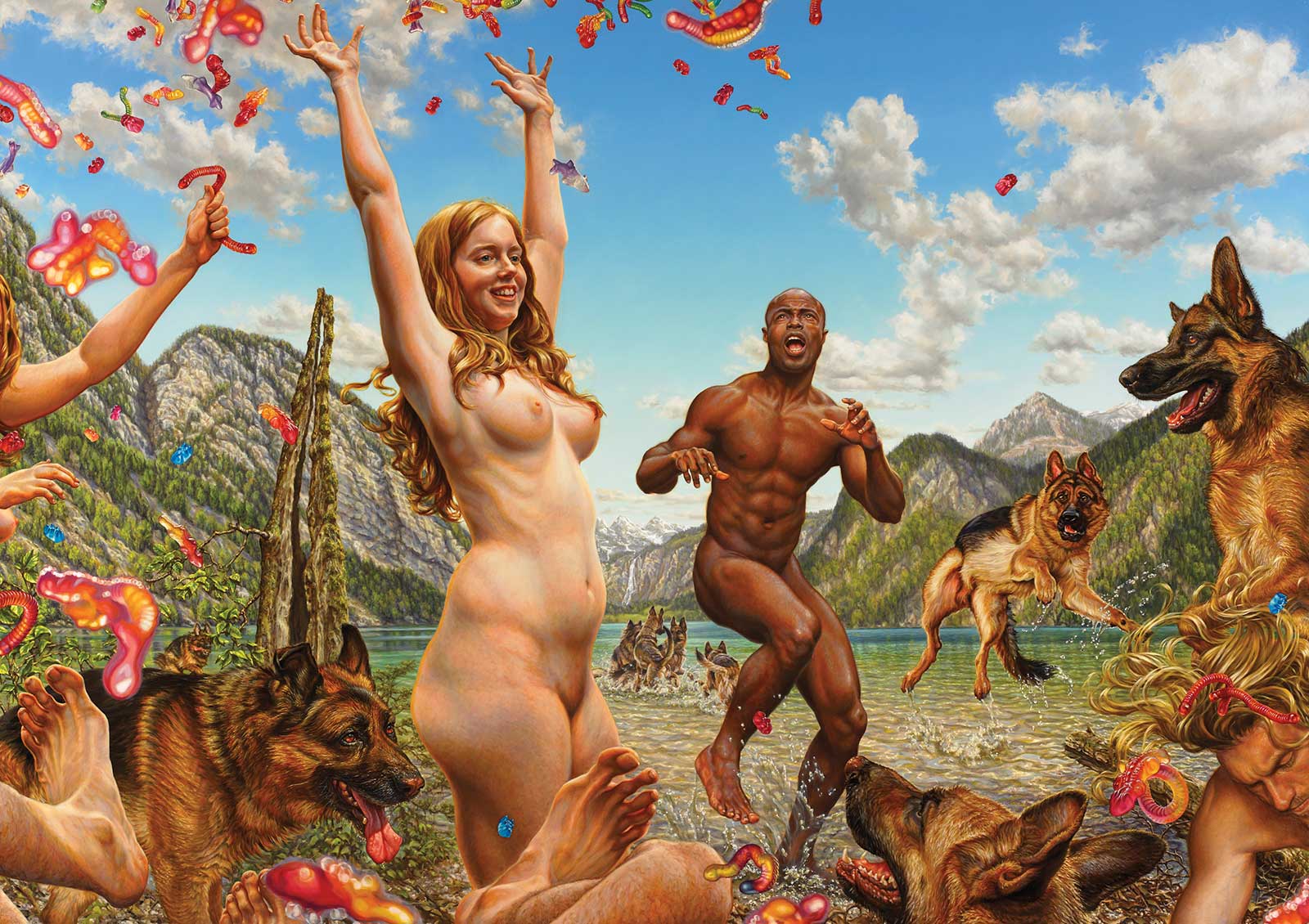 Bavaria, oil on linen, 2018, 67 x 94½"
Martin lives and paints in Germany, the birthplace of Lutheran Protestantism, a place one might expect to be the home of puritanical zeal directed against displays of the naked body, which was once seen as the vessel of original sin, and the exciting stimulant of wicked lust. But for two centuries Nietzsche’s heimat,or homeland, has been home to an enthusiastic alternative lifestyle movement, among whose participants there is a popular consensus that being naked in nature is essential for living the healthy and good life, for bathing in the benevolent light of the sun, for feeling the gentle breeze caressing skin, and swimming nude in the fresh water in blessed lakes. Nudity is normal. Nineteenth-century Germans birthed holistic medicine, modern vegetarianism and organic farming. Germans were early entrants into secular communal living, seeking alternatives to conventional religion and creating a current of countercultural bohemianism opposed to bourgeois life.
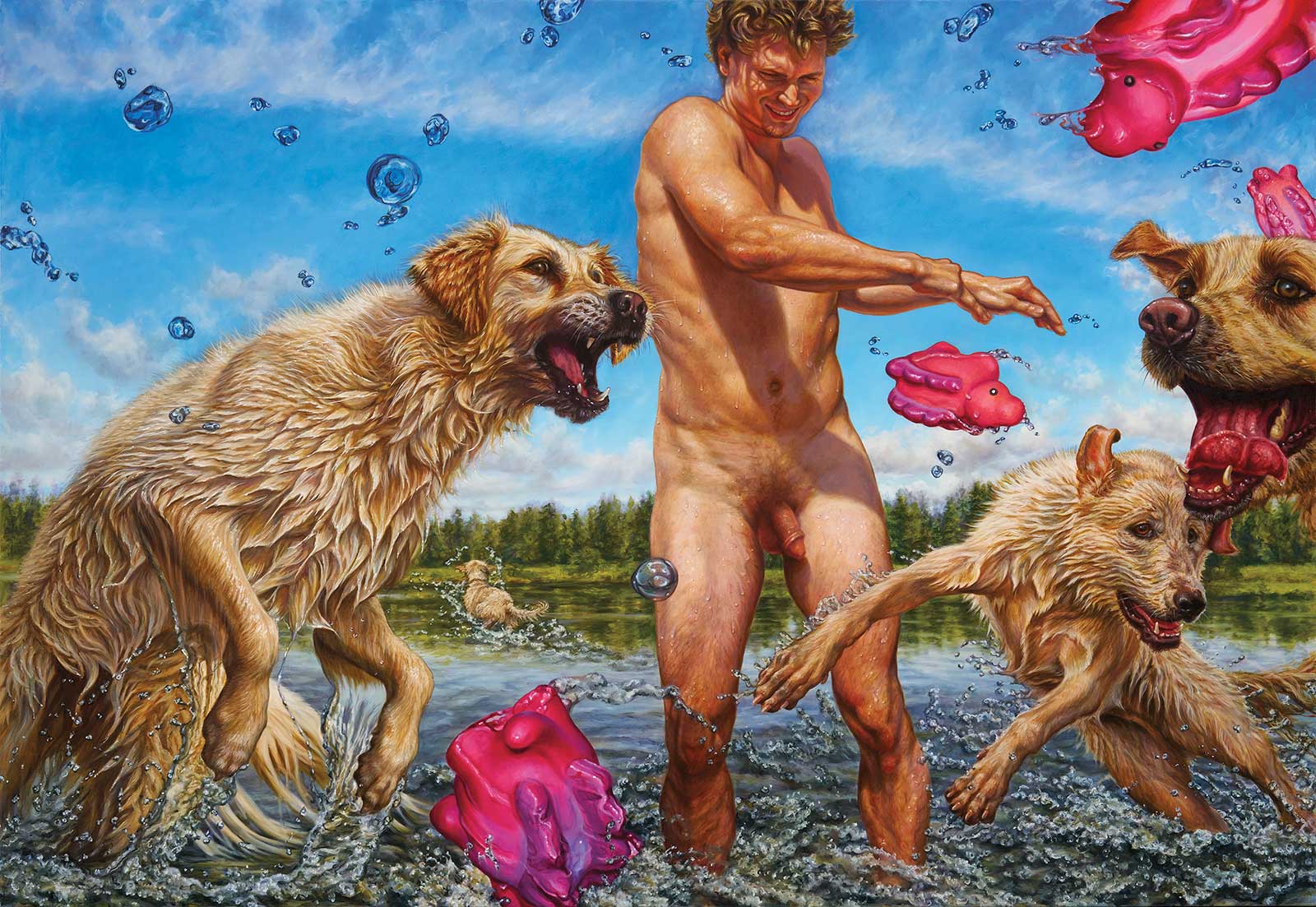
The Retrievers, 2023, oil on canvas, 403/10 x 6"
Germany was the birthplace of modern physical fitness. Although Martin is a brilliant realist painter, these naked bodies do not belong to reality, for they are bodies of desire—not only of erotic and sexual desire, but also desire for well-being, vigor, and delight. To the bohemian family of the free, Martin’s paintings of frank and sensual bodies are an invitation to witness and admire health with honest and guiltless pleasure in the shared and shameless freedom of nudity.
Martin studied art at New York University and faced the pragmatic necessities of survival in the city early on. “I wasn’t a trust fund baby,” she says. Her career began in scenic painting for film and photography, but she soon tired of the work and abandoned it for fine art. In 2010, she began painting the figure, deliberately working as a realist with a clear gaze upon the fundamentals of flesh under light. She continues, “I wanted to approach a classic theme of nude and landscape from a very contemporary perspective, a very realistic perspective, and not romantic. I wanted to see if I could extract that romantic element from it.” But Martin’s understanding of the boundaries of reality had been stretched by her youthful experiences with hallucinogens. “I’ve never discussed it with anyone,” she reveals. “It’s something I’m allowing to come out in the work more and more, going into that in-between space of reality and whatever lies beyond it, and drawing on those early psychedelic experiences as well…It requires a certain amount of courage. How to integrate these things? That’s the tricky part.”
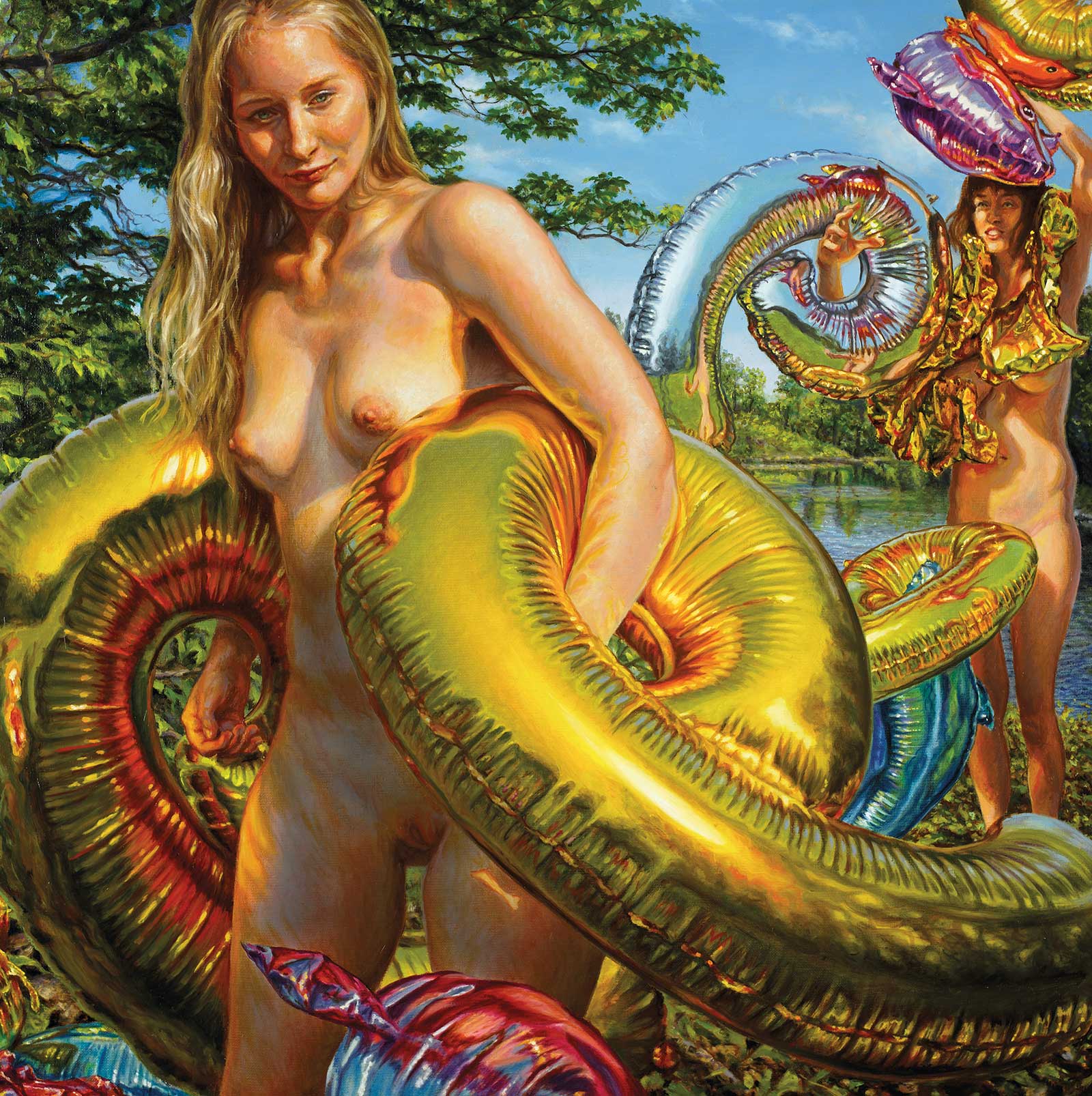
Reservoir, 2018, oil on linen, 20 x 20"
The psychedelic experience was therapeutic and had a profound influence on her art. “It’s very much about that transcendental psychedelic experience in total freedom, which was my experience of that drug,” she says. “I like to go back to that time and think about what does it feel like to actually be free. That’s the happy element. That’s why I loved psychedelics. It took me out of a more-or-less traumatic childhood as a teenager. There was a lot of trouble. I had to work a lot. My father died early, and my mother wasn’t present. So, to me, when I discovered psychedelics in my teens it was like going on vacation. It felt more like home than this world, to get away from the trouble of paying the rent and getting through school, it was a lot of pressure at a very young age. In between I took a break and did some psychedelics with friends, and it was such a relief, frankly. There was a lot of joy there. It was always a positive experience for me. It gave me hope at a critical moment, as crazy as that sounds.”
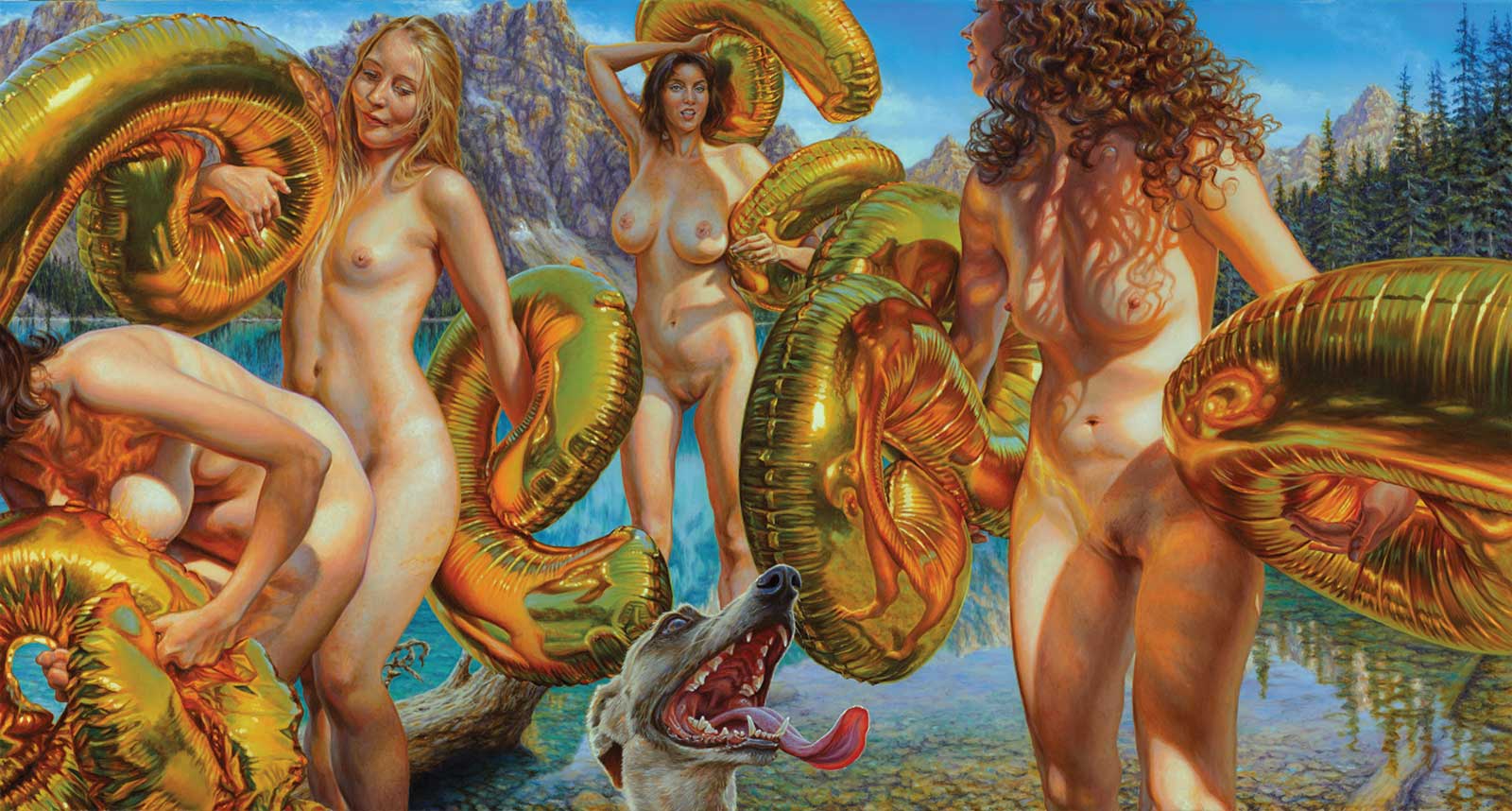
Helium, 2017, oil on linen, 32 x 59"
But the paintings are also a semiotic carnival and cavalcade of iconic meanings. At least since Plato wrote about art and ideas, images have been read as allegories, and interpreted, and there is a natural desire to translate the paintings as Martin’s messages to her audience, for the creation must always reflect the mind of the creator. Her impulse to fill many of her paintings of sensual nudes with shiny sixes cannot be easily ignored, for if there was ever a number to attract the excitement of apocalyptic attention, it is the number of the beast in the Greek Revelation of John, and Martin certainly must expect the scrutiny that comes with this choice. But her upturned allusions to biblical iconography, and her deliberate disregard for its conventions are clues to her approach to the old tradition of emblems and their meanings. Martin’s sixes are numerological symbols, shiny shibboleths offered as easily punctured balloons, destined to release only squeaky and high-pitched helium gas. They are trivial icons of beasty nonsense only fit for children’s play, and their presence here provides fulfilment of a momentary and juvenile pleasure in bright and shiny objects, as superficial distractions from the weight of serious things. The burden of conspiratorial biblical exegesis is deflated. Sixes aren’t always apocalyptic. In many Asian cultures, six is the most auspicious of numbers, bringing good fortune. Sixty-nine is also the conventional sign of mutual oral pleasure, and in the hands of these naked figures, they are a message of erotic play. The balloons are signs of liberty. Martin reveals the new era of postmodern symbolism accessible to 21st-century painters.
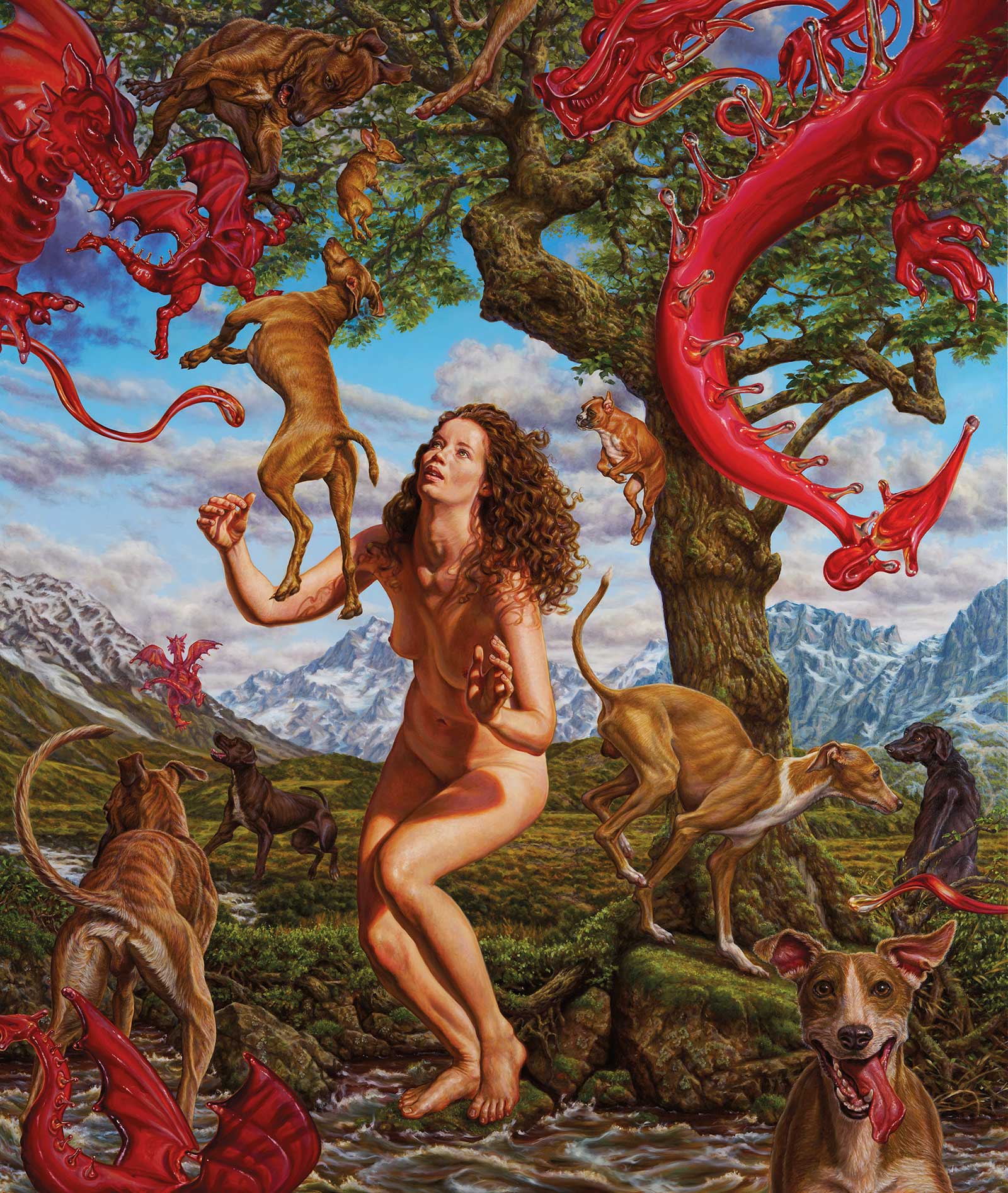
Drachenjagt (Dragon Hunting), 2023, 704/5 x 863/5"
Emblems are not easily interpreted in the plural culture of the internationally woven tapestry of 21st-century imagery, and Martin’s iconic choices are certainly not welded to religious orthodoxy—they sing the tunes of a broader symbolism. Her joyful paintings are celebrations of freedom from the constraints of convention, but not a rejection of symbolism itself. Christian dragons were a potent symbol of the other, of the alien, of evil, but the Daoist dragon is the potent image of masculine energy, which must be nurtured and treasured as the symbol of virile potency and life. Dogs are ancient emblems of faithfulness, and as Martin’s laughing hounds are released from the chains of dogma, their joy is her freedom. In the West, bees are images of industriousness, of brotherhood, of selfless devotion. In Swarm, Martin’s gigantic and inquisitive bees bumble about bright Aglaea, happy Euphrosyne, and blooming Thalia, the three ancient graces cast dancing among the busy insects. But these diminutive nudes are also Alice after the drink-me potion, and full of the joy of mushroom medicine, and the bees are communicative beings. Martin says, “Another way I’m exploring levels of consciousness, and perspective is through scale. I’m also messing with art history, obviously—the idea that humans were more important than nature. Nature was usually something blurry in the background.” Martin’s art is a postmodern playtime in an expanded garden of iconography.
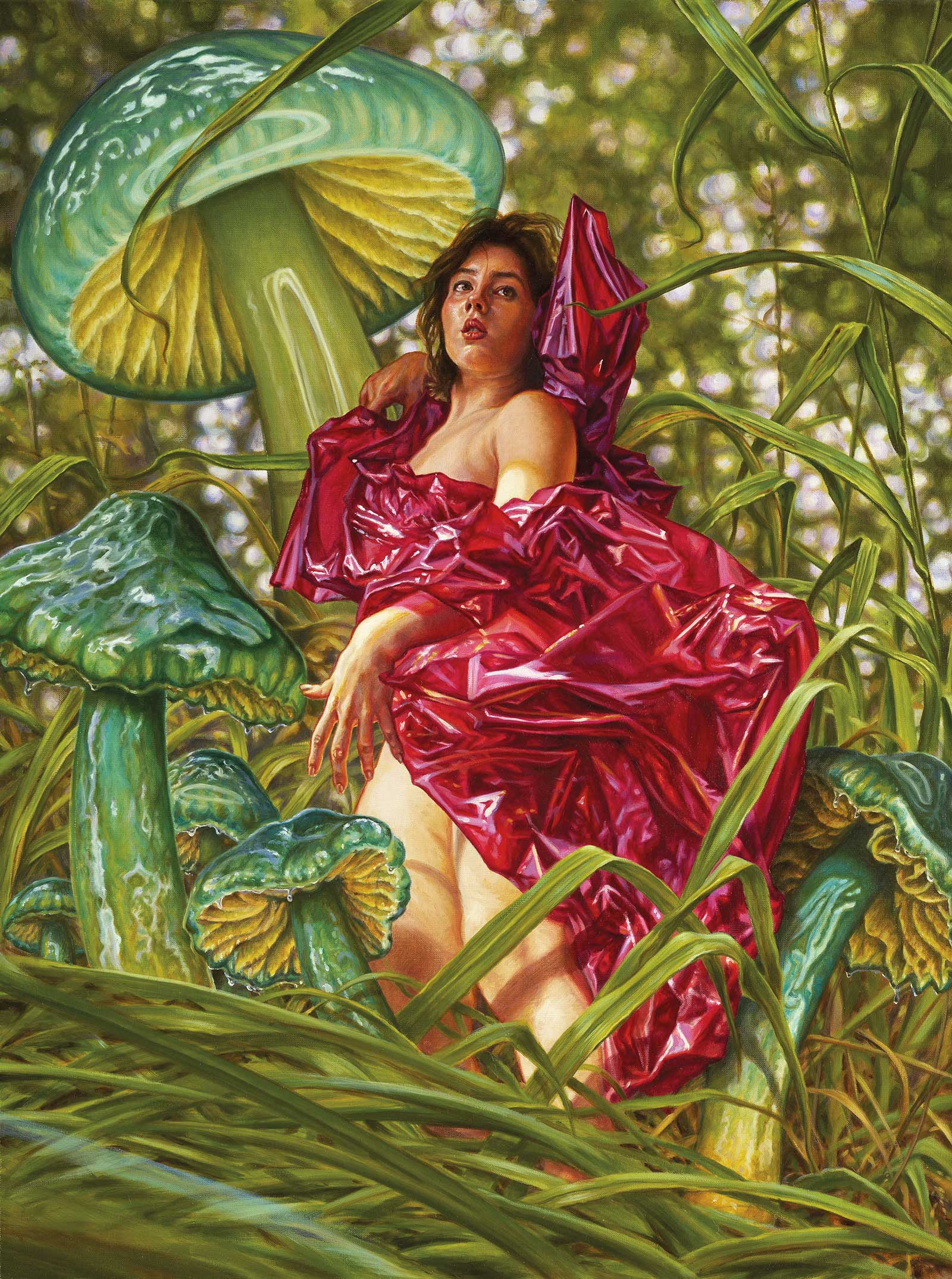
Mazateca, 2022, oil on canvas, 233/5 x 31½"
The old order of orthodox meaning is broken then, and emblems are fluid and open to new interpretations, and may have multiple meanings—at least until liberty is crushed by the emergence of a new and authoritative system of hegemonic belief—and Martin’s paintings are a celebration of that fluidity. Martin is a post-modern trickster sharing her delight in critiquing and reinventing representational symbols, even the weighty symbol of the body, under the spell of her own iconography.
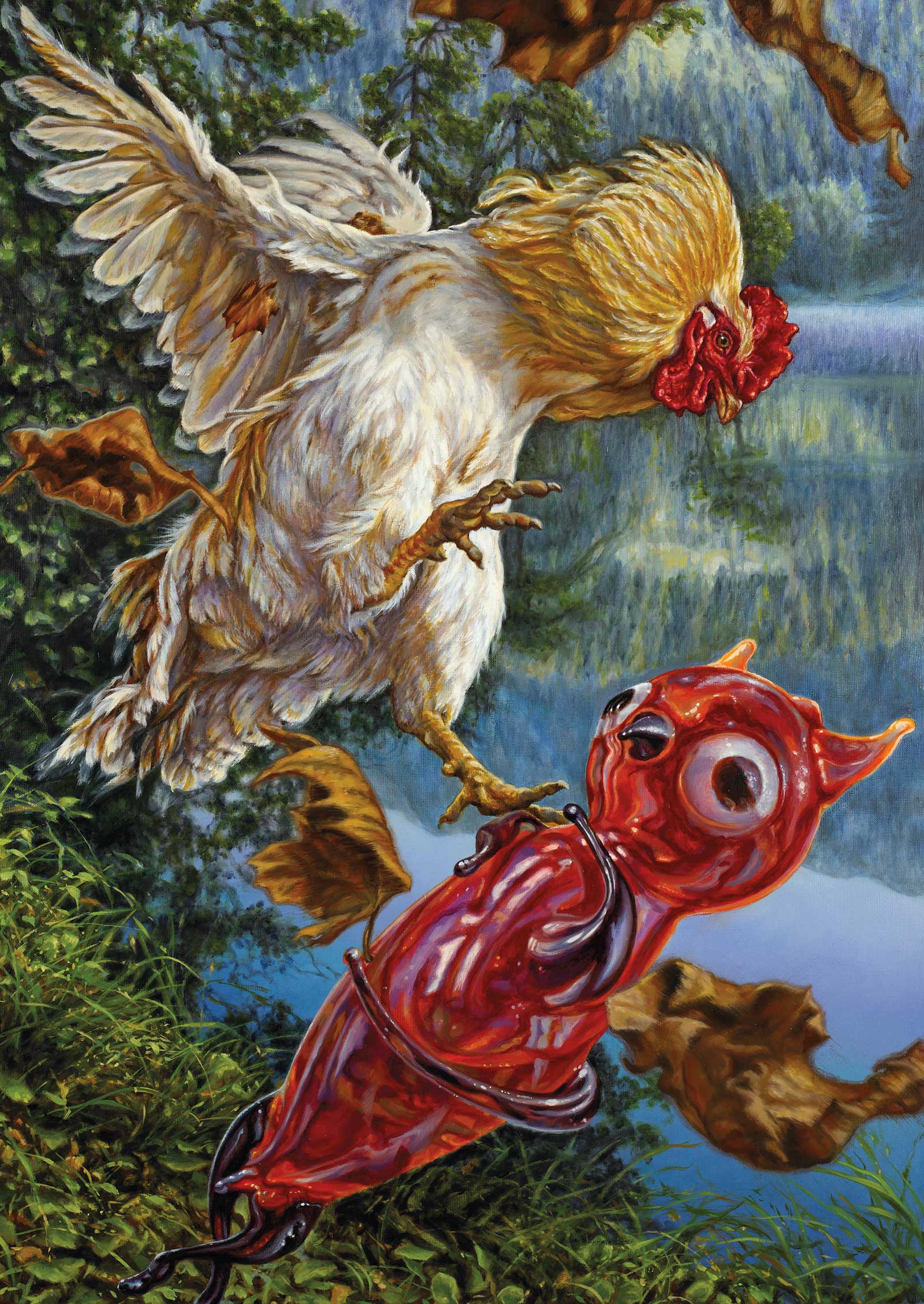
Der Hahn und der Teufel (The Rooster and the Devil), oil on linen, 193/5 x 27½"
The paintings are neither naïve visions of utopia, nor a lexicon of the apocalypse, nor some heretical species or clever mockery of faith. Martin has entered a playful, yet serious journey into exploring the modern meanings of emblems. The cheerful barking of the lively dogs and the sound of splashing are silenced here, and the noise of play is as frozen as the balls and blobs of weightless water held in space as shining and reflective jewels, each captured motionless in a split second of super-slow and shuttered speed, each manifested in an impossible moment of reality. And if sound is frozen, then so is the word—the word of creation that breathes all things into becoming; the word that means all things have meaning, the still small voice silenced, the instant stilled, and the blunt balance and equation of time and space and dimension bent. Time stops here.
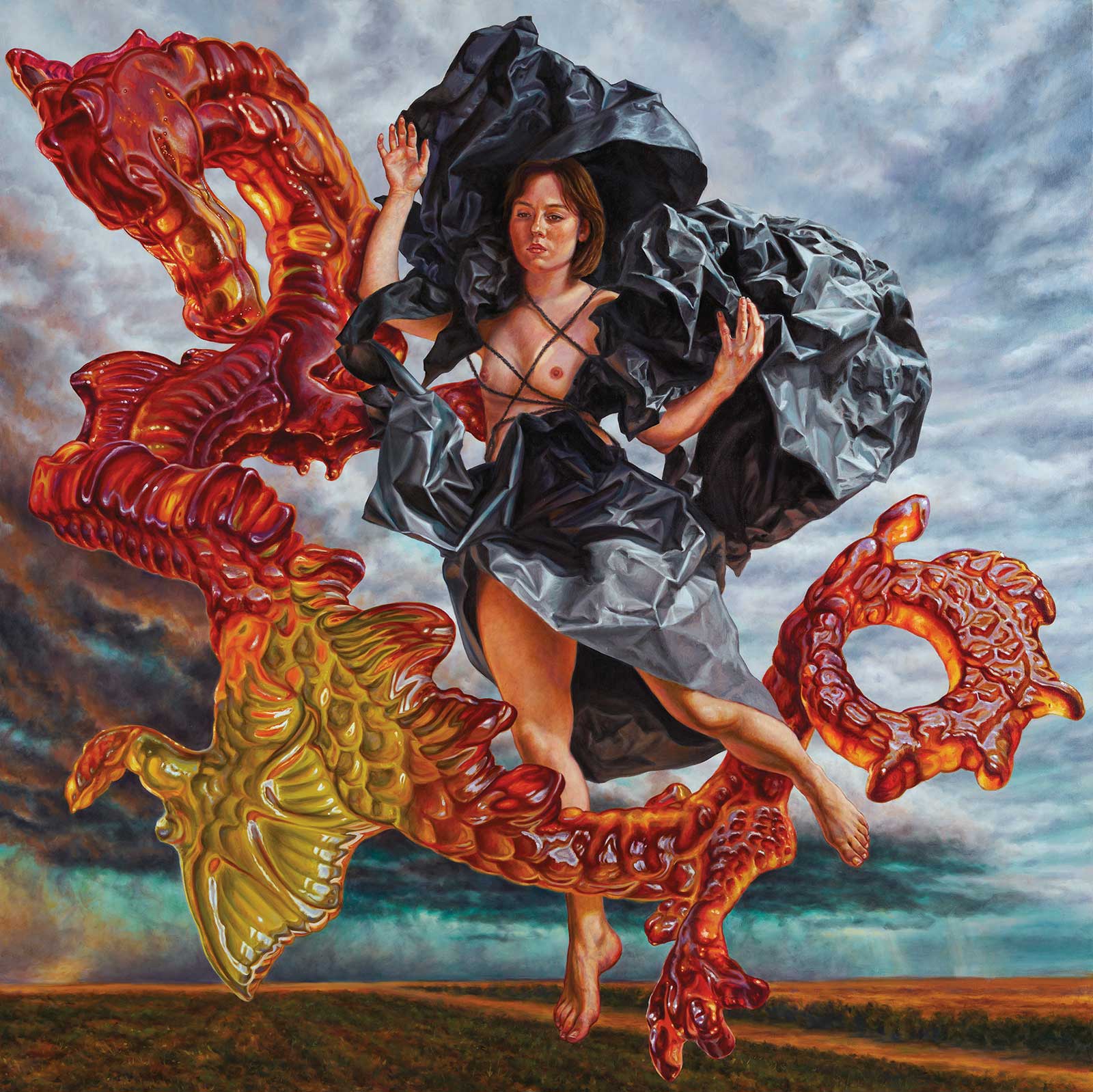
The Arrival of the Angel of Death, 2023, oil on canvas, 51 x 51"
And if these mirrored splashes of weightless water reveal frozen time, then these dragons, too, must be held in the split of dimensions, encapsulated as momentary extensions of their being, as indices projected into the mineral and watery planes of earthly existence. Emblems are eternal symbols with a life of their own, passing through time as manifested entities which appear in moments caught by artists capable of representing them. Their meanings transform as they appear in different cultures, and different ages. And if the dragons and the dogs, the water and the bees reveal themselves as multi-dimensional manifestations of emblem idea-beings appearing on many planes, then so do Martin’s beautiful people. We, too, are changing creatures of the multiverse, of joy, of revelation. —
Powered by Froala Editor